Over the course of two days, you will be guided through a series of case studies and implementation models that fully illustrate the key concepts of building Enterprise-level AI systems.
When combined with the Supertype-authored Agentic Patterns, you achieve a harmonious, end-to-end workflow for Agentic AI implementation that we refer to as blueprints. My goal with this workshop is to help you get hands-on with constructing these blueprints, so that you, too, can confidently build out enterprise-grade AI applications for your organization.
Early Bird Freebie
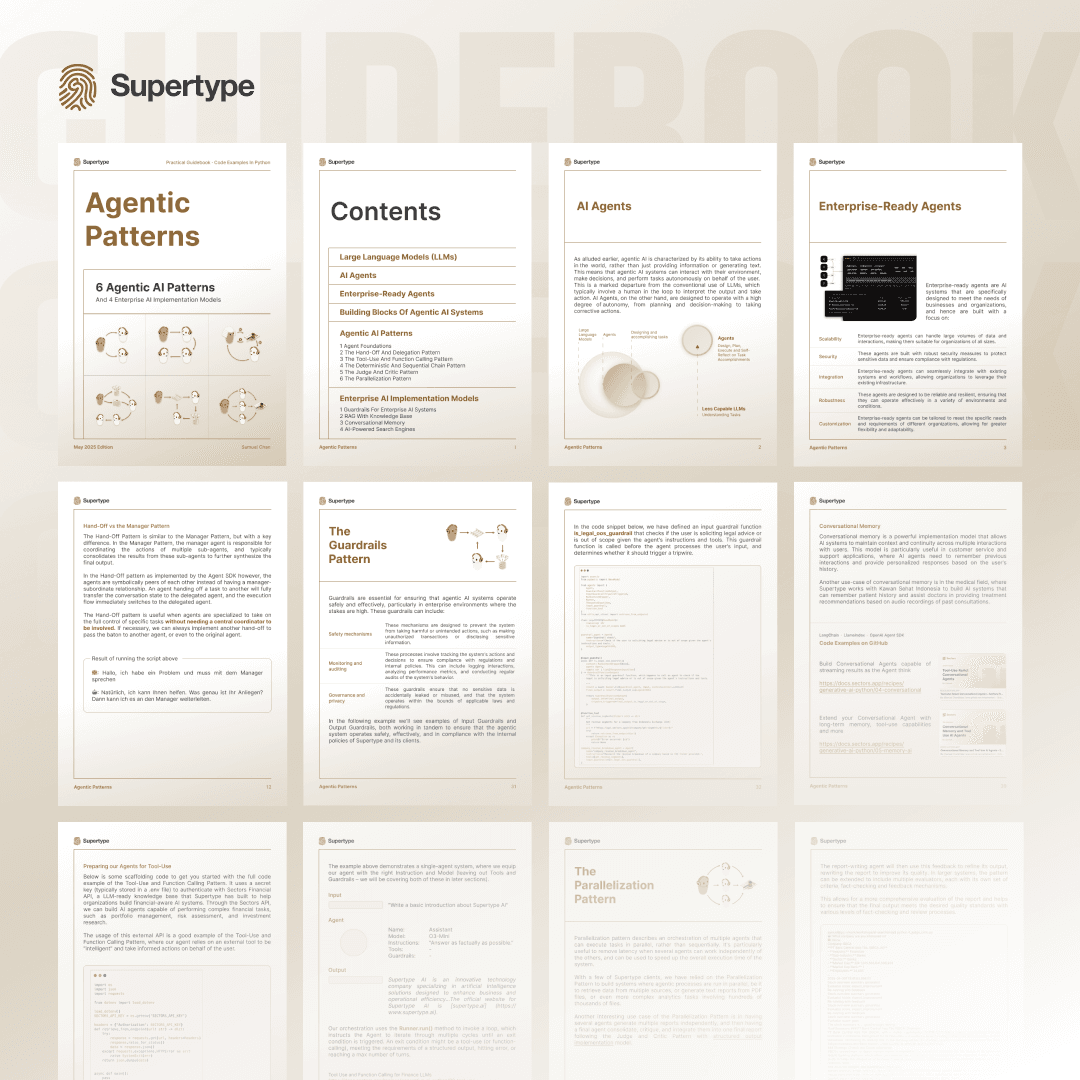
Register early to receive a copy of the 60-page e-book on Agentic Patterns, revised and updated for Q1 2026.
This e-book is a great companion to the workshop, and provides great reference materials to the Agentic Patterns section of the workshop.
These building blocks are modular and reusable, allowing developers to create complex systems by combining them in different ways. This modularity enables rapid development and deployment of agentic AI systems, as developers can easily assemble pre-built components to meet specific requirements.
Excerpt from Agentic Patterns, Supertype Publication
Agentic Patterns
Established paradigms of Agentic AI engineering.
- Building Blocks of Agentic AI Systems
- 6 Agentic AI Patterns expanded from Supertype's publication (updated for 2026)
- Practical examples and case studies
Agentic Implementation Blueprint
Grouping AI implementation into front-end and back-end phases.
- Backend: The gut that powers AI applications (ingestion, retrieval, knowledge management).
- Front-end: Enterprise chatbots, AI Search, Report Generators, and more.
- 4 Enterprise AI Implementation Models from Supertype's publication (updated for 2026)
Engineering best practices for enterprise AI
An inside-out approach to building enterprise AI applications: LEAVES
- 1. 4 Kinds of Pipelines: Initialization, Trigger, Periodic, and On-Demand
- 2. Enterprise Chatbots: Memory-capable, Retrieval-Augmented, and Logging
- 3. AI Server: Report generators, LLM-powered APIs, and more
- 4. Knowledge Management: AI-powered content synthesis and indexing